User’s role on the game of interaction
Visual culture studies recommend that image research and image interpretation should be a prerequisite of a corresponding education. Why not image interaction as well?
 |
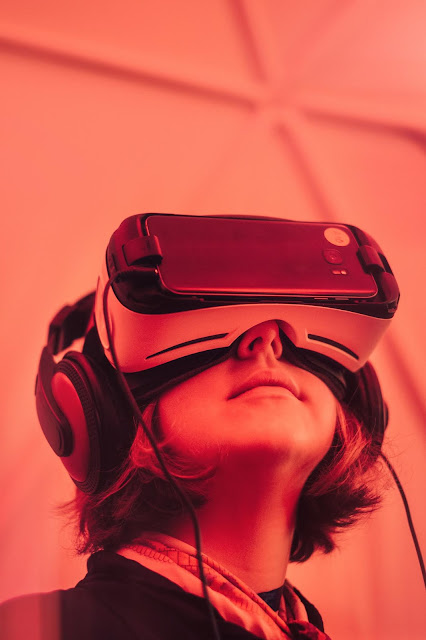
| Photo by Patrick Tomasso on Unsplash |
The designed display of a website is nothing more or nothing less than an image, that follows the norms and philosophy of the digital world. For this purpose, dimensions ought to have the potential for adjustment in ten different types of screens; contrast displays should cater for both low-cost screens as well as high-performance Retina displays; font-size should meet its purpose while fetching content; a web page’s layout should either respond to or adapt to the screen’s size; information should be structured in a logical way for uninterrupted sequential browsing; and this is to name only a few of the suggestions that fall under the title of the design brief. Above all however, whether designed to fit physically in a pocket, intended to spread on a three-monitor desktop station or projected in our home cinema room a designed screen is an image.
The very role of the creator nowadays has become restricted and redefined by such design specifications and guidelines that are settled by the medium, by the principles of proper design and, of course, by the client!
The creator is no longer a single graphic designer, but, rather, an holistic designer. The reason for such a term-transposition is that the processes that constitute the art of creation get more and more complex as the requirements change. Sometimes, the desired image can no longer be achieved through a single static approach, and therefore the creator has to search further to build the resulted image by navigating through dynamic elements and at times pure code. Therefore, a modern web designer should be thought as an image developer.
The vast majority of modern image production services are meant to satisfy a certain purpose, either on print or digital form, including advertisement services, packaging, news items, media and web services. Especially with regard to the web, an image results from the pre-designed bits of information that roll over a user’s screen without a stop for as long as user keeps interacting with them.
At this point I would also like to mention the user who, in his modern version, carries his or her own culture and experiences. This modern user is not satisfied merely by reading an article and commenting on it for his own sake. This user has a great desire to spread his or her comment beyond his or her immediate surroundings by using every possible social media account that he or she administers.
But let me intervene at this point with a bit of related history…
Historically, the revolution of image occured when its massive reproduction became available. With this milestone, all social masses gained access to the image itself which fostered their visual education and the building of a visual culture. People could from that time on spread ideas and theories, settle art movements and find supporters, simply because they held a point of reference in their hands. As images kept spreading to masses around the world and as they kept acquiring larger and larger dimensions, their exposure increased. Anyone could now comment on an image, just because, as opposed to the pre-revolution era, a huge amount of material was now readily available in front of their eyes.
When the web materialized, the revolution reached its peak. It was now much easier to create and reproduce images, and even easier to share them. As a result, images started being misused. Individuals were now capable of not only passively commenting, but also of expressing their views in a visual way. They could now oppose wide held views on image and, finally, through a smart use of the power of mass media, establish new standards.
Nevertheless, throughout the history of technology, by passing from television to multimedia, the human eye has been an observer, a witness of storytelling. All these years of image production and practice have led this linear continuity of sequential images to a level of exceptional integrity, which in its turn prevented the very first weak steps of interaction. The viewer however, has now been transformed into a user, who knows that there is more now to what has been, who learnt and got used to a new reality and who is now expecting something more from each new era. This user has moved from the very first static pages with textual content to dynamic pages full of banners and back to dynamic informational pages; from the blank background into gradients and back to white. During each era the user expects to get something on screen that he or she will be able to understand. For instance, if the contemporary trend is named “facebook”, the user expects a “like” under each article on the web.
We are now redefining the notion of the modern user. This user that finds himself or herself with a life spent in front of a television, or, for younger ages, in front of a PC monitor, and is equipped with and carries around at least one screen in his or her daily commute. His tolerance alone towards all this amount of visual information that bombs his mind gives him the right to comment on what he or she sees. Though, does this certain tolerance give him also the right of criticism?
Throughout my professional experience I have designed images for many organisations, agencies, companies, ministries, clubs and groups of people. Many images were from the outset doomed to be viewed in older versions of browsers due to contractual reasons, or due to client’s unwillingness to invest on compatibility. Charts and statistics show that only a small percentage of the entire population of users keeps their devices updated, which means that most of them are not consciously concerned of improving their digital world experience, by updating for instance their browsers to the latest version or by adjusting the screen resolution.
Hence, the designer is left with the realisation that the image to be finally delivered in a production process will only approximate the image that he initially suggested by convention since the user has not fully realised those powers that could be considered as the ‘fifth element of interaction’. Hence, McLuhan is once again fully justified! The screen that the user carries each single day in his or her daily rides, whether a mobile phone, tablet or computer, is indeed the medium through which he shapes the image given to him or her.
It is not until the user has apprehended his or her involvement in interaction that the realisation of his or her own visual culture can begin.
It is only through this certain active involvement that a respectful act of criticism against image can be achieved.
It is only through this certain active involvement that a respectful act of criticism against image can be achieved.


Comments
Post a Comment